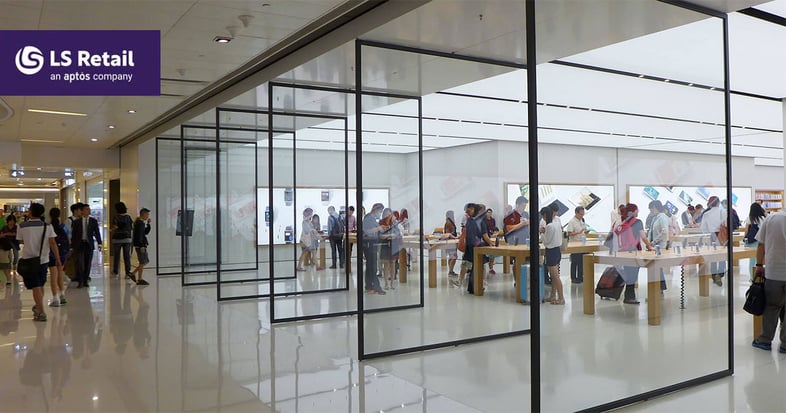
Apple Stores rank among the highest-performing retail spaces globally in terms of sales per square foot. They sell a focused product range at premium prices, rarely discount, and avoid aggressive sales tactics.
But brand power alone does not explain why the stores remain consistently busy.
Apple also benefits from an exceptionally strong ecosystem and a loyal customer base. Not every retailer can replicate that advantage. What can be replicated, however, is the operational discipline behind the experience.
Below are practical principles that apply to any physical retailer.
1. Stop measuring success only by transactions
Apple Store employees are not paid on commission, there are no upsell quotas, and there are no pressure scripts. Every interaction is centered on solving a customer's problem rather than maximizing basket size, which shifts the entire performance model. Instead of optimizing purely for conversion rate or average transaction value, the focus expands to repeat visits, customer satisfaction, and long-term value.
Retailers that prioritize metrics such as retention rate, customer lifetime value, and net promoter score tend to build more durable performance than those chasing short-term sales uplift. The operational implication is straightforward: incentives shape behavior, and behavior shapes experience.
2. Let customers handle the products
Every device in an Apple Store is powered, accessible, and ready to use, with customers encouraged to explore at their own pace and without restriction. This is a deliberate design choice rooted in a well-documented behavioral concept known as the endowment effect: people tend to assign higher value to items once they feel a sense of ownership, even temporarily. Physical interaction builds familiarity and reduces purchase hesitation in ways that no product description or display can replicate.
The operational question for any retailer is whether products are genuinely accessible or whether layout, packaging, and display policy are quietly working against a sale. Store design signals intent, and customers read those signals quickly.
3. Ask before you recommend
Apple staff are trained to understand a customer's situation before suggesting anything, with the goal being suitability rather than price maximization. Executing this well requires more than soft skills: staff need immediate access to inventory availability, product specifications, pricing rules, and, where relevant, customer history.
When employees have to leave the floor to check stock or confirm a price, the interaction stalls and credibility takes a hit. A retail management platform like LS Central means staff can check stock, confirm pricing, and pull up customer history without stepping away from the conversation, keeping the interaction focused on the customer rather than the system.
4. Remove friction from checkout
A queue at the till can undo an otherwise strong store visit, and Apple addressed this early by minimizing fixed checkout counters almost entirely. Staff carry mobile POS devices and process payments wherever the customer happens to be standing, while shoppers who prefer to handle it themselves can scan and pay through the brand's app without any staff involvement.
Flexible checkout is no longer a differentiator, it is what customers expect. The real operational challenge is not offering multiple payment options, but making sure every option draws from the same live inventory, pricing logic, and loyalty data. When payment methods operate in silos, discrepancies emerge and the experience fractures. When they run through a single connected system, checkout becomes fast, consistent, and largely invisible. LS Central's self-checkout and ScanPayGo, which lets customers scan items as they shop and pay directly from their phone, are built on that logic. Friction reduction, ultimately, is less about the hardware on the floor and more about the alignment behind it.
5. Hire for attitude, then train for knowledge
Apple's hiring process prioritizes curiosity, patience, and communication skills over technical knowledge, on the practical basis that product details can be taught but interpersonal disposition is much harder to develop in someone who does not already have it. A knowledgeable but disengaged employee damages experience regardless of how much they know, while an engaged employee with good system support can deliver both accuracy and warmth.
At scale, this distinction matters significantly. Recruitment criteria and training investment need to reflect it, which means being deliberate about what you are actually selecting for when you hire.
6. Give your team a clear, repeatable service framework
Apple distils its customer service approach into a structured five-step interaction model: welcome, understand, present, resolve concerns, and close. The steps are simple enough to memorize and consistent enough that customers get a recognizably similar experience across every Apple Store in the world.
The value of a framework like this is not the structure itself but the standardization it creates. Variability in service quality is a risk, particularly across multiple locations, and a defined interaction model reduces that risk while also making training faster and more consistent. Service frameworks are not about scripting personality out of an interaction, they are about making quality predictable.
7. The beginning and end of a visit matter most
Apple staff greet every customer who walks in and thank every customer who leaves, regardless of whether they made a purchase. This aligns with what psychologists call the peak-end rule: people remember the beginning and end of an experience far more vividly than what happened in the middle, meaning a warm welcome shapes the entire tone of the visit, and a genuine goodbye is what customers carry with them when they leave.
For retailers, this translates into a concrete operational standard rather than a soft aspiration. Entry acknowledgment and exit engagement are controlled touchpoints with a measurable influence on return behavior, and they cost nothing beyond consistency.
The point is not to copy Apple
When customers can purchase nearly any product online within minutes, a physical store has to justify the visit on grounds other than convenience or price. The differentiator is structured human interaction, accessible products, empowered staff, and systems that remove operational friction. Apple's minimalist design is the part that gets written about, but the process discipline running underneath it is what actually sustains performance.
Retailers that align their incentives, information flow, service standards, and checkout infrastructure around customer confidence can apply that same logic regardless of brand scale or category.
If you are evaluating your store systems against these principles, explore LS Central or speak with our retail team.